
Why Scotland’s families are smaller than they want to be – and what Logos Scotland’s research reveals about the gap.
Falling birth rates in the UK are a quiet tsunami that is slowly making its way through our society. It is little talked about, seldom acknowledged and yet will have the biggest repercussions for our policy makers for generations to come. Our school rolls are falling, recruitment in some key industries is difficult, a pension time bomb is developing and yet Governments are not talking about it or doing anything about it. Short term politics has always been an issue in our country and this issue promises to be one of its biggest challenges.
The Times reported on 13 October that the falling birth rate was not because women no longer wanted to have children; it’s because many were unable to have the families that they want, when they want them.
Mothers surveyed said that they wanted 2.4 children but actually had 1.6. 38% had become mothers later than they intended by an average of 6 years.
These findings seem to suggest that families are getting smaller, not by choice but by circumstance.
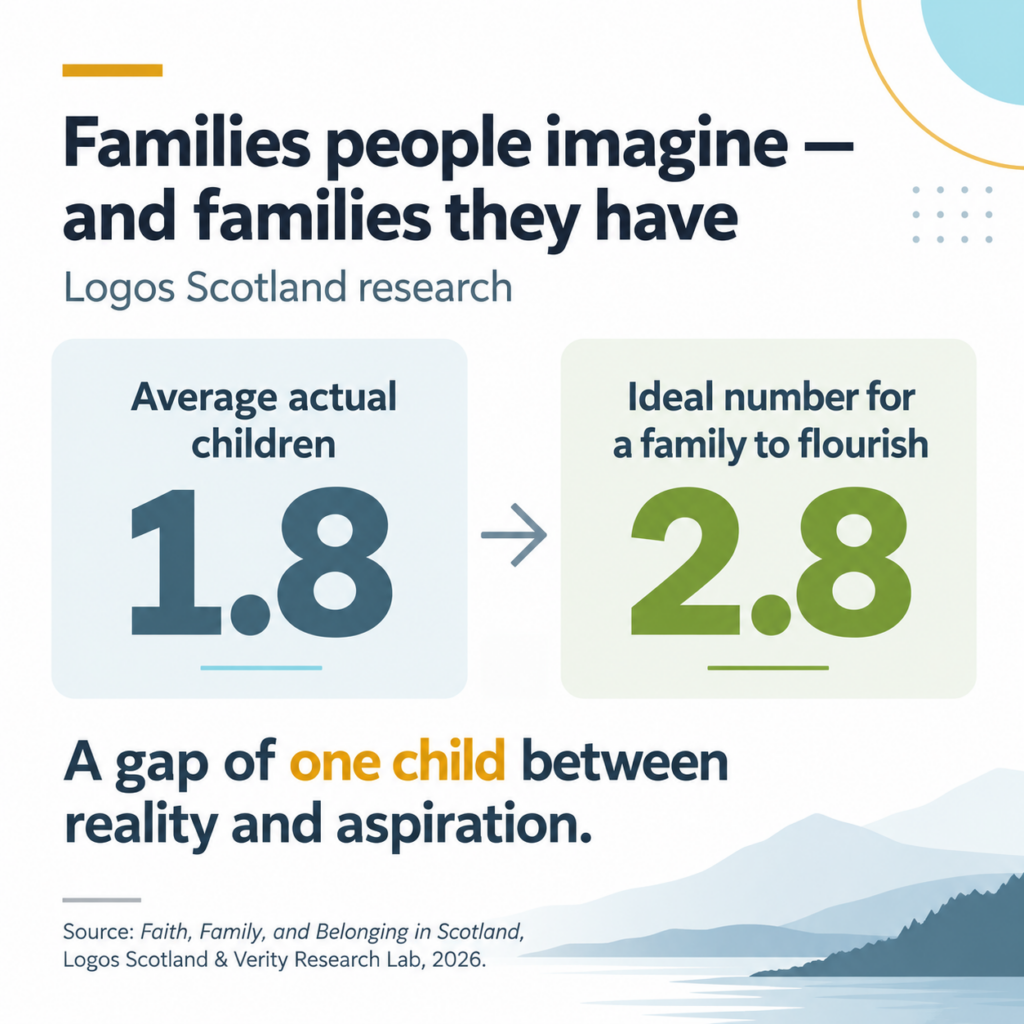
The Times survey mirrored research that was done by Logos Scotland, through the Verity Research Lab earlier this year that found very similar figures for Christians in Scotland. In our report Faith, Family and Belonging in Scotland we surveyed 1,016 Christians in Scotland between August and November in 2025. We found that Christians in Scotland felt that in order for society to flourish parents should have 2.8 children. However, they were actually having 1.8 children. This is slightly above the figures from The Times but not by much.
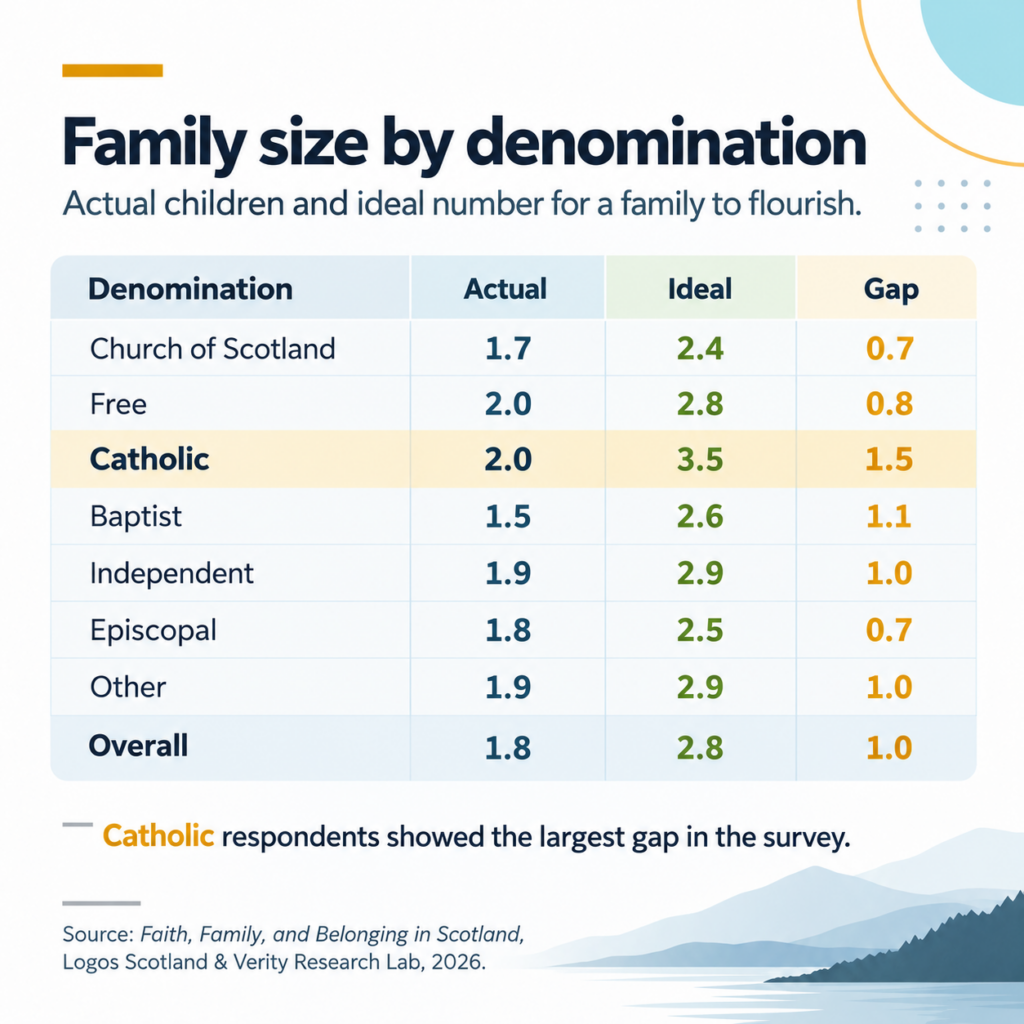
What was particularly interesting in the Logos survey was that Catholics, who you would expect would want and have more children, were not that different to other faiths. Catholics felt that in order for society to flourish families should have 3 children, but when asked how many children they had the average was 2. Catholics had the biggest gap between the ideal and the reality of all of the denominations surveyed. It seems that every group is finding that family ideals are easier to articulate than achieve.
What is clear is that the want, or the conviction, to have more children is not the whole answer, there are clearly societal barriers in place that are preventing parents from having the size of family that they aspire to.
In June 2026, the Institute for Family Studies in the USA produced a similar report. They found that those identifying as conservative politically thought that 2.71 children was the ideal number, but only had 1.4. Those from a liberal standpoint thought 2.16 children was the ideal but only had 1.09. A similar finding was part of the Logos Scotland research with those considering voting for Reform considered 3.3 children the ideal for flourishing, compared to 1.9 among Christian Green Party supporters.
There are not only economic and demographic factors affecting our birth rates but there is also an ideological basis at play that is often overlooked.
So what is preventing people from having children in the UK today? The Times article states that women were having children around 6 years later than they planned to. Clearly financial considerations, career paths and finding a partner are all factors in when people start their families, and we know that this is getting later in life.
We cannot simply say that people should have more children while making it increasingly difficult for them to build the families that they want.
This, of course, begs the question: what would a ‘family starting’ friendly Scotland look like?
There are the structural things like affordable housing, access to childcare, employment flexibility and financial stability that, it could be argued, are all pretty much in place in Scotland. We have free childcare from age 3, with assistance for over twos for some groups. House prices in Scotland are lower than elsewhere in the UK, maternity rights in the workplace are world leading and we have a relatively good standard of living (although the cost of living crisis is hitting hard at the moment).
But are we falling into the trap of describing children as a financial liability, career obstacle or lifestyle sacrifice? Have we lost the joy, the blessing, the purpose of having children and creating a family?
Children and families are not merely economic inputs. Relationships, belonging and intergenerational connection matter and are central to human flourishing. Children are not just future taxpayers or workers. They are people, and family life is worth supporting for its own sake.
Through the research done by Logos Scotland, and also reported in The Times, we have evidence of a gap between aspiration and reality across both religious and wider populations. The challenge is understanding and addressing the reasons for it. Governments can only do so much through policy, and already do a lot. But there is more to consider. How can we help people meet and start families earlier, or feel more financially secure at a younger age? How can we give parents the confidence to have the families they want? Perhaps part of the answer lies in recognising that few of us ever feel completely financially ‘ready’ to have children. Sometimes we need the confidence, and the support, to take that step.
We need to empower people to grow their families. Perhaps Scotland’s greatest demographic challenge is not persuading people to want more children, but building a society in which those who do want them feel able to welcome them.